The Billion Dollar Domain Market: Why Agent and Agentic Domains Will Shock The World

The internet is about to undergo its most significant naming shift since the original dot com boom.
AI agents are not a feature update. They are a new class of actor on the internet. They will need identities. They will need endpoints. They will need names.
And the domains that name them will become some of the most valuable digital real estate ever created.
This is not speculation. This is infrastructure logic playing out in real time.
The question is not whether agent and agentic domains will matter. The question is who understands this early enough to position correctly.
From Models to Agents
AI models live behind platforms.
AI agents live in the world.
They interact with APIs. They initiate payments. They manage data. They represent users, firms, and protocols. They coordinate with other agents. They deploy other agents. They operate continuously without human intervention.
This shift changes the value of surface layers. Apps, dashboards, and interfaces become secondary. What matters instead are endpoints, identity, and coordination primitives.
In every distributed system, names harden early.
DNS already exists as the most global, resilient, and machine compatible naming system ever deployed. As agents proliferate, domains become the most natural place for them to live.
The Scale of What Is Coming
Consider what happened with cloud computing.
In the early 2000s, domains containing “cloud” were available for registration fees. Cloud storage, cloud computing, cloud services. All sitting unclaimed because the market had not yet recognized what was emerging.
By the time Amazon Web Services reached scale, those domains had repriced by orders of magnitude. The ones that remained available commanded six and seven figures.
Agent infrastructure is following the same trajectory, but faster.
The difference is that agents are not just a service category. They are an execution layer. Every industry vertical, every financial function, every protocol stack will eventually have agent infrastructure running through it.
That means agent health, agent finance, agent legal, agent energy, agent defense, agentic capital, agentic payment, agentic protocol. These are not niche plays. They are category defining names for systems that will process trillions of dollars in economic activity.
The total addressable market for agent naming is not millions. It is billions.
What Are AI Agent Domains
AI agent domains are domains whose names map cleanly to functions, roles, or institutional primitives that autonomous agents are expected to perform.
They are not brand experiments. They are infrastructure nouns.
The pattern is simple and powerful:
agent + function or agentic + function
This mirrors how infrastructure naming has always worked in technical systems. Role plus capability. Clear, parseable, extensible.
These names describe what an agent does, not how it looks.
Why Hyphens Are a Feature, Not a Bug
Hyphens have historically been treated as a weakness in domain names.
That assumption comes from a brand driven internet where domains were primarily designed for human recall and marketing aesthetics.
AI agents change that equation entirely.
Agent and agentic domains are not brand slogans. They are machine legible descriptors. Clarity matters more than visual smoothness. Function matters more than feeling.
Agents Parse Meaning, Not Vibes
AI agents do not read domains the way humans do.
They parse structure.
A hyphen creates an explicit boundary between role and function. It removes ambiguity. It makes intent obvious at the character level.
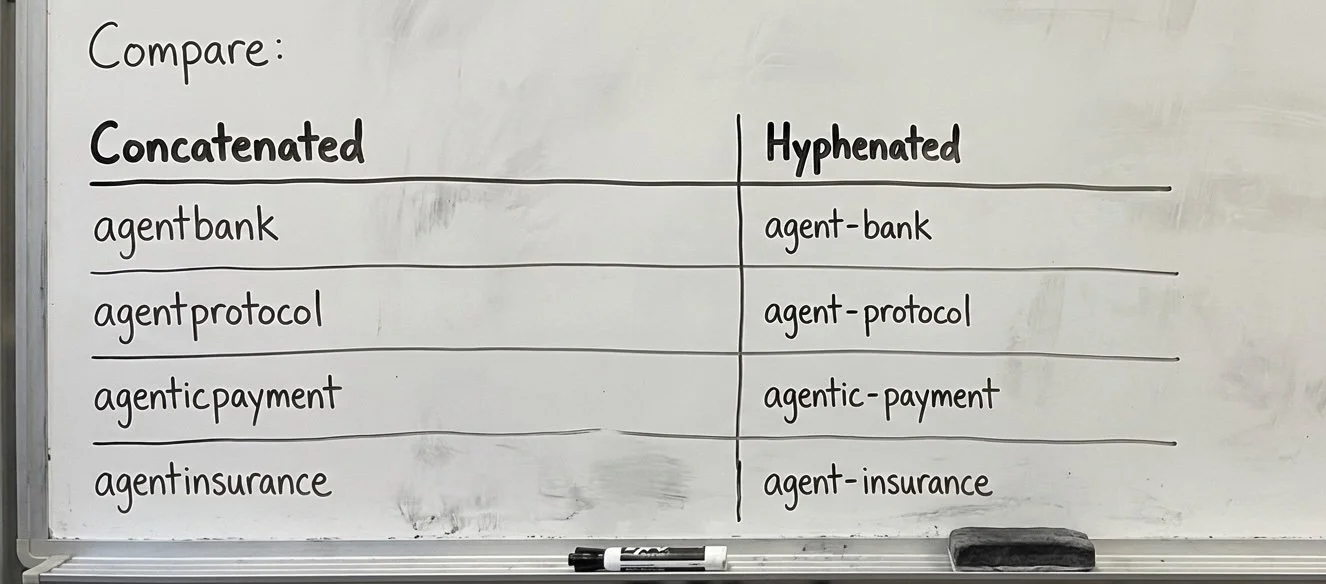
For a human, both columns are readable with minimal effort. For a machine parsing strings, resolving endpoints, or categorizing system roles, the hyphenated version is unambiguous.
This matters when domains are used as API identifiers, routing surfaces, protocol namespaces, or authentication endpoints inside automated systems. In those contexts, parsing precision is not a nice to have. It is a requirement.
DNS Is Already Hyphen Native
There is a persistent myth that hyphens are somehow second class citizens in the domain name system.
This is false.
Hyphens are explicitly supported in the DNS specification dating back to RFC 1035 in 1987. They are not hacks, patches, or workarounds. They are a native part of the naming system that has powered the internet for nearly four decades.
Some of the most important technical standards, protocol bodies, and infrastructure institutions in history have relied on hyphenated naming precisely because they needed precision over aesthetics.
AI agents inherit that legacy. They are technical systems first. Their naming conventions should reflect that.
Hyphens Reduce Naming Collisions at Scale
As the agent ecosystem grows from hundreds to thousands to millions of autonomous systems, naming collisions will multiply exponentially.
Hyphens provide a structural solution.
Consider the difference. “Agentcore” could mean a company called AgentCore, a product core for agents, an agent named Core, or a dozen other interpretations. “Agent-core” has one natural reading: the core infrastructure layer for agents.
This disambiguation becomes critical for institutional domains where misinterpretation carries legal or financial liability. It matters for protocol namespaces that need to remain stable and parseable for decades. It matters for multi agent systems where routing precision directly affects performance, security, and auditability.
Hyphens Signal Infrastructure, Not Marketing
This is subtle but important for understanding how these domains will price.
Hyphenated domains tend to signal internal tooling and developer infrastructure, protocol layers and specification bodies, system endpoints and API surfaces, institutional and enterprise positioning.
Non hyphenated domains skew toward consumer brands and direct to user marketing, lifestyle and media properties, retail and e-commerce storefronts.
In an agent native economy, infrastructure sits upstream of brands. The protocol layer captures value before the application layer. The API gateway prices higher than the marketing site.
Hyphens signal that upstream positioning instantly to sophisticated buyers. They communicate: this is infrastructure, not a landing page.
The Sector Map
The early agent domain market is organizing itself around sectors where automation pressure is highest and institutional capital flows deepest.
Finance and Capital
Financial infrastructure will be among the first sectors to see full agent integration. Payments, lending, investment management, and treasury operations are already being automated. The naming layer for these systems is forming now.
Core Financial Infrastructure
agent-bank.orgagent-capital.orgagent-money.comagent-credit.comagent-credit.orgagent-payment.orgagent-payments.orgagent-loan.comagent-loans.orgagent-insurance.orgagent-insure.com
Agentic Finance Layer
agentic-capital.orgagentic-money.comagentic-credit.comagentic-credit.orgagentic-fi.comagentic-fi.orgagentic-payment.orgagentic-payments.orgagentic-loan.comagentic-loan.orgagentic-loans.comagentic-loans.orgagentic-insurance.orgagentic-insure.comagentic-insure.orgagentic-wealth.comagentic-invest.comagentic-investment.comagentic-investments.comagentic-swap.com
Investment and Venture
agent-venture.comagent-ventures.comagentic-venture.comagentic-venture.orgagentic-ventures.org
Health and Biotech
Healthcare and biotechnology represent trillions in global spending with massive automation potential. Agent systems will increasingly handle diagnostics, research coordination, patient management, and drug discovery workflows.
Agent Health
agent-health.comagent-health.orgagent-medical.comagent-bio.comagent-bio.orgagent-care.org
Agentic Health
agentic-health.orgagentic-medical.orgagentic-biotech.comagentic-care.org
Law, Policy, and Governance
Legal and regulatory systems are information dense and rule based. Perfect terrain for agent automation. Contract analysis, compliance monitoring, policy research, and legal coordination will all move to agent infrastructure.
Agent Legal
agent-law.comagent-law.orgagent-legal.comagent-legal.orgagent-policy.org
Agentic Legal
agentic-legal.orgagentic-lawyer.orgagentic-policy.org
Energy and Environment
Energy systems are already highly automated. Agent infrastructure will extend that automation into trading, grid management, sustainability reporting, and resource coordination.
Agent Energy
agent-energy.comagent-energy.orgagent-earth.comagent-earth.org
Agentic Energy
agentic-energy.orgagentic-earth.comagentic-earth.org
Defense and Security
Defense and security applications represent some of the highest stakes deployments for autonomous systems. Naming in this sector signals institutional grade infrastructure.
Agent Defense
agent-defense.comagent-defense.orgagent-security.orgagent-safety.org
Agentic Defense
agentic-defense.orgagentic-safety.org
Research and Science
Research coordination, data analysis, and scientific discovery are being transformed by AI. Agent systems will increasingly manage research workflows, literature review, and experimental coordination.
Agent Research
agent-research.comagent-research.orgagent-science.comagent-science.orgagent-study.comagent-study.orgagent-labs.org
Agentic Research
agentic-research.orgagentic-study.comagentic-study.orgagentic-labs.orgagentic-intelligence.org
Infrastructure and Compute
The technical backbone of the agent economy. Cloud infrastructure, software systems, robotics, and platform layers.
Agent Infrastructure
agent-cloud.orgagent-software.orgagent-platform.orgagent-robotics.comagent-api.orgagent-data.org
Agentic Infrastructure
agentic-cloud.orgagentic-software.orgagentic-platform.orgagentic-robotics.orgagentic-api.orgagentic-data.orgagentic-factory.orgagentic-space.org
Protocol and Standards
Perhaps the most valuable category. Protocol names and standards bodies anchor entire ecosystems. These domains represent potential governance and coordination layers for the agent economy.
Agent Protocol
agent-protocol.orgagent-standard.orgagent-core.orgagent-layer.orgagent-foundation.orgagent-global.orgagent-logic.com
Agentic Protocol
agentic-protocol.orgagentic-standard.comagentic-standard.orgagentic-core.orgagentic-layer.orgagentic-foundation.orgagentic-global.comagentic-global.orgagentic-network.orgagentic-id.org
Commerce and Industry
Commercial infrastructure and industrial automation. These domains map to the transactional and operational layers of the agent economy.
Agent Commerce
agent-commerce.orgagent-industry.comagent-house.comagent-support.orgagent-strategy.comagent-education.org
Agentic Commerce
agentic-home.comagentic-house.comagentic-help.orgagentic-support.orgagentic-strategy.org
Decentralized Systems
The intersection of agent infrastructure and decentralized coordination. DAOs, decentralized finance, and autonomous governance structures.
Agent DAO
agent-dao.comagent-dao.org
Agentic DAO
agentic-dao.comagentic-dao.org
The Pattern from Previous Cycles
The pattern is consistent across technology shifts.
Early internet: protocol names hardened before mass adoption. Cloud era: API and platform naming preceded scale. Crypto: layer, protocol, and infrastructure names captured outsized value before retail attention arrived.
AI agents follow the same path.
Naming hardens early. Interfaces change later.
The domains accumulated during the quiet period become the ones that matter during the loud period.
The Repricing Event That Is Coming
Here is the market reality that creates the current opportunity.
Most domain investors, registrars, and buyers still apply human brand heuristics to machine native assets. They see a hyphen and instinctively discount. They evaluate agent-protocol.org as if it were a consumer website rather than potential critical infrastructure.
That creates systematic mispricing.
Agent and agentic domains with hyphens are still available, still affordable, and still dramatically underestimated relative to their structural alignment with how autonomous systems actually work.
This gap does not last forever.
The repricing event will come from two directions simultaneously.
Enterprise adoption. As major technology companies, financial institutions, and infrastructure providers begin deploying agent systems at scale, they will need names. They will discover that the obvious names, the ones that clearly describe what their systems do, are already held. Acquisition conversations will begin. Prices will reset.
Protocol standardization. As industry bodies, standards organizations, and open source communities formalize agent protocols, they will anchor on specific naming conventions. The domains that match those conventions will become canonical. Everything else will become second tier.
Both of these forces are already in motion. The timeline is not decades. It is years.
The .agent TLD and What It Signals
ICANN’s next new gTLD application round is expected in 2026.
The .agent TLD is coming.
When it arrives, the naming conventions and market expectations established in the current .com and .org namespace will heavily influence how .agent develops. Organizations that already hold agent-[function].org or agentic-[function].com will have natural positioning to acquire or operate the equivalent .agent names.
More importantly, the .agent TLD will validate the entire category. It will signal to the broader market that agent naming is a real and distinct asset class. It will bring new buyers, new capital, and new attention to a space that is currently understood by very few.
The domains accumulated now will benefit from that validation event.
The Billion Dollar Market
Let me be direct about the scale of what is emerging.
The premium domain market has historically produced individual sales in the eight figure range. Voice.com sold for thirty million dollars. Cars.com sold for eight hundred seventy two million dollars including the business built on it. Insurance.com sold for thirty five million dollars.
Those were category defining names for industries measured in hundreds of billions.
Agent infrastructure will be measured in trillions.
The autonomous economy is not a vertical. It is a horizontal layer that touches every vertical. Agent finance, agent health, agent legal, agent commerce, agent energy, agent defense. Each of these represents a category as large as the industries those legacy domains named.
A portfolio of premium agent and agentic domains is not a collection of speculative bets. It is a position in the naming layer of the next internet.
The market for these assets will be measured in billions of dollars. The only question is timing.
Why the Market Still Looks Quiet
Early infrastructure markets always look inactive before they matter.
Liquidity arrives after relevance, not before it.
Most people still associate domains with marketing websites. That mental model is outdated. In an agent driven world, domains function as identity anchors, routing points, trust surfaces, and coordination addresses.
There are no auctions yet. No hype cycles. No viral moments.
Just quiet accumulation by people who understand how systems form and how naming becomes expensive only after it becomes obvious.
By the time AI agents feel commonplace, the relevant domains will already be owned. Not advertised. Not promoted. Just unavailable.
That is how infrastructure markets always begin.
The Takeaway
Hyphens in agent and agentic domains are not a compromise.
They are a feature.
They encode clarity, role separation, and machine readability in a system that increasingly belongs to autonomous software rather than human browsers.
The conventional wisdom from the brand driven internet says hyphens are a weakness.
The technical reality of the agent native internet says they are a structural advantage.
In that context, hyphenated agent domains are not worse than their concatenated alternatives.
They are earlier.
And in markets defined by timing, earlier is everything.
